What you need for a good Barbie repaint

I recently saw that lots of you are interested in the topic of repaint but I found no good video summing all thing you need in a video up. Some videos only show the direct repaint. Some videos only show the brushes, palettes or color but there’s no video where you find all parts combined in one video and giving you some bonus beginner mistakes to avoid.

What’s easier than doing it yourself when you don’t find the correct video for the topic you want to cover. If you want a video showing you an actual repaint, no problem use this here

From my experience I can tell you it’s not always easy to have the right things for repainting at the same time at home. That’s what I have within some years and I think it’s useful for most of you. I don’t think neither have heard about Liquitex ( when you are living in Europe neither from Da Vinci artist brushes). That’s why you should update your knowledge. It is useful to think about these items first, then you buy them and don’t have any negative surprises while you are working.

I bought mine over the last couple of years. I had no idea where to start neither where to buy. There were no videos on youtube. Of course there are some bigger channels than mine here doing repaints. On some channels you have millions of viewers but I don’t have them but want to inform you about repainting as good as I can. What is really helpful for the hobby of repainting is to get yourself a wet palette. I can’t tell it often enough but this little thing is a game changer. You can keep your colors liquid for at least a week. From my experience this is enough time for doing a proper repaint. I hardly needed more than a week. The sponge is great for this. The costs you have are around 25€ for this. It’s always a little depending on where you buy it.

Then you have the colors. I can’t recommend it often enough to use good quality color. The reason why I show here Liquitex colors is that when you use the cadmium free version of this color you don’t have any fear that the color will leave permanent color traces in the rubber of the head. You can see this sometime on Barbie dolls like my Jewel Hair Mermaid Teresa. She’s a nrfb doll but after 25 years somehow the color started to bleed into the adjacent rubber. Have look about what I talk about.
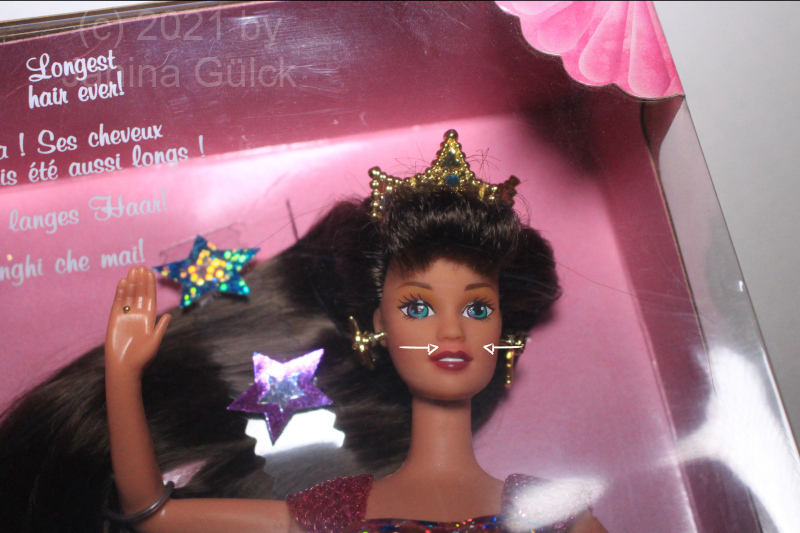
JHMT
Jewel Hair Mermaid Teresa with some traces of bleeding color

I know it’s very subtle but it’s happening and I simply want to warn you that this could happen to you too in case of using cheap or incorrect color. It’s not that everything is perfect in the Barbie world. I never said this but for future projects we can avoid the problem when we know where it comes from. That’s at least what I think here.

The biggest problem I had when I wanted to start with repaint was the brush question. I heard from other collectors what they used. I bought the brushed, made my first strokes and found out that they were way to thick for my problems. Later I accidentally came across very fine and thin brushes suitable for the project. I use a lot of Da Vinci Micro Nova brushes. They are not cheap but I’m satisfied. Since 2021 you can also buy the bend versions you can see in my videos.

Another problem I had when doing repaint was the color consistency. For most of the projects the paint was way too thick. I only use undeluted color for the white dots in Superstar Barbie eyes. For all the other projects I thin the color out. The wet palette is your friend here. Even if you have used way too much water it’s no problem. You have to wait a day and then the color will be okay again. Very helpful for beginners. So I hope that this little article gives you some more background information to understand what to do and what to avoid when going shopping or doing your very first repaint. Keep in mind what you need for a good Barbie repaint.
Have you ever tried to re-crimp Barbie hair

When you grew up in the 90s you know what I’m talking about. If not let me tell you that crimped hair were wide spread in the 1990s not just for dolls. Especially in the early 90s this was a big thing. Even my cousin had a crimping iron. I did not know about this whole trend until she explained her crimping iron to me in 1995 or 1996. I know this is rather late for crimping irons but they still exist. You can still buy them today but the trend as big as it was in the 1990s disappeared somehow. Mainly due to fashion reasons I think.

Maybe they come back in some years like many trends come back every 20 or so years. I’m showing you a pic of what I’m talking about.

https://www.instagram.com/p/CZvV35WFC4p/?utm_source=ig_web_copy_link

Anyway Mattel used this unique hair technique to make the Barbie dolls look like they were very hot, cool, stylish, trendy. In my childhood almost all of the Barbie dolls I knew had these waves. In my world these waves had no names. One could not imagine that it might change one day with the waves. I know this sounds crazy especially when you came to Barbie later or earlier but in the 90s these crimp waves were huge. However with in the almost 3 decades that passed by since these crazy crimp waves appeared for the first time. Many dolls have somehow lost their waves. My Totally Hair Barbie suffered under this problem almost from the beginning. I think she lost her waves after being braided with a normal 3 stand braid for a longer time period. So this phenomenon is not new to me but I search for ways how to restore these waves and try to make them look like they were freshly deboxed. This is not always easy because most of the time they are missing a lot of hair in their ends due to the fact that the hair fibre used mainly is Kanekalon hair. Some rare dolls also had Saran hair and their hair stayed intact. You can see this when you search for Hollywood Hair Barbie and compare the offer with Totally Hair Barbie dolls on ebay. Hollywood Hair Barbie never had this problem. The reason is the fiber. I never understood it as a child. That’s something I learned along my way as a collector.

In the 1990s we find mainly Kanekalon hair. It’s the cheapest kind of hair that can be mass produced. Maybe that’s the reason why a lot of these 90s Barbie dolls had a huge amount of hair at first? After the first tangles they had less and less hair. That’s also the reason why the ends of the Totally Hair Barbie/ Ultra Hair Barbie can often be found with very thin ends. Tangles – the dead of every Barbie doll with Kanekalon hair. If you compare this fibre with earlier Barbie dolls from the 1960s, 1970s or 1980s the 90s is the first decade where the problem of general Barbie doll hair loss appears.

Now let’s turn back to the main problem with the waves. Kanekalon as a fibre is easy to work with. You can bring the hair in any form you want and you can curl the hair with every curler or curling iron you have. The art here is to find a way that your doll hair keeps this position permanently and here my job starts. I try to show you easy to follow ways to get your doll to a shape as good as new. This is not always easy and a lot of testing is necessary for good results but you get them as soon as they are available. If you have ever tried to re-crimp Totally Hair Barbie or Ultra Hair Barbie successful let me know your recipe.

Broken Barbie necks, missing joints and how to attack this wide spread problem

When I come across problems with broken Barbie necks there are mainly two things, very wide spread in this area. One thing is that you can find the older neck joints very often in the head of the dolls. They simply left the body and popped somehow into the head.

That’s also the first problem I ever came across when I kept my childhood dolls, got them from the attic a while ago and one of my Skippers hit the floor. So the problem that the neck joint disappeared into the head happened. The head fell off and I thought she would really be broken. I think it happened some 20 years ago. I really thought she was broken and threw her away. To be honest this was one of the biggest mistakes I ever made since starting to collect these dolls. There were no guides or indications that simply hot water would have saved this Camp Fun Skipper to be thrown away. I learned all the things that I teach you here much later. Another Skipper, my Teen Skipper was sitting for years on a stair head. One day she fell of. The head, the joint and and the body stayed intact. The only thing she got from this adventure during my absence is a very thin hairline crack. I know she has it but I ignore it and nothing will happen. She’s in one of my showcases.

But what to do when you have a case like mine? Throwing the doll away? Possible but unnecessary as I learned later. There’s a very easy solution to get at least the neck joint out of the head again. You only need a bowl with hot water, a towel and a little patience to get the joint out of the head again. The head itself is made out of rubber. When you heat it up a little bit the head becomes very flexible and it is very easy to get the joint out of the head again. That’s what you can see in the first part of the video. I recommend not to treat the broken hairline cracks if you want them to stay invisible. Often you hardly see that there are cracks when the head is back on.

What do you do when a big part of the neck is broken smoothly out of the neck? Does it make sense to throw the doll away then?

I would say no. If you don’t have the stuff to repair the body immediately it’s no problem just store the broken out piece and the body together so that you know where the body as a whole is. Maybe store it in a zip lock bag?

Good idea! That’s at least an idea how to fight against broken Barbie necks, missing joints and a solution to attack this wide spread problem. But when you want to leave this ” I put her in a zip lock bag” -status? That’s very easy said with a few words. Get yourself MEK to solve this problem. The background why not to use normal glue is that I was told by a lot of collectors that they got problems with using glue. Their arm and neck joints literally crumbled away within the years the dolls were glued. That’s why I recommend to melt it back on. MEK or 2 Butanon is a solvent. We careful when using it. It is said that this stuff can lead to cancer when using it too often. It also needs 24 hours to dry completely but I think it’s okay when we have a normal doll back after the time. For the missing joints I can recommend to replace them. Often you find replacement joints in bundles/ lots with lots of heads. In the last year it was no problem to get them. What do you think? Let me know in the comments.

The function of the Supersize Super Hair Barbie

Often when Supersize Barbie dolls are offered their hair is cut or they have other issues so that they are not perfect anymore. For one of the problems I made a video. It’s about the mechanism of the Supersize Super Hair Barbie.

She has a pull string mechanism similar to the one used for Talking Barbie. Some of you may think …. well that’s outdated. You are right up to a certain degree but the fact that the mechanism is working that simple brings us to the point that it can be repaired again once it’s broken.

I imagined something like a stick in her hair & her head and I thought that the string is attached to this stick in her head somehow. The understanding of the mechanism is correct up to a certain degree but it does not work with a stick but a simple plastic ring and to this ring is the string attached that comes out of her neck again. I admit I thought the hair would come out easier. It’s sometimes a little hard to pull but it works and it works for more than 40 years. How many toys with function do you know that work without problems until today?

That’s still a kind of quality work, isn’t it? Which device has worked for you the last 40 years without any failures? I don’t know much devices. Probably a fridge, a freezer or a mixer would still work but the energy efficiency is very bad.

Nevertheless I think it is possible to repair her. The missing or cut hair can be replaced with new hair and the mechanism can also be restored. The ring should not be very hard to replace. For the line I would use fishing line and the ferrules are also available online. All parts should no be hard to find. From this point of view a repair should be possible without any problems. Like always you need the skills to repair the doll. In my opinion the only hard thing to find is the pink ring in her back but it’s possible to use something else to replace the ring if you want. It’s up to you … like always.

Talking Barbie vs. Kissing Barbie who is easier to repair

Sometimes it’s hard to explain but in the last week I had the idea to tell you a little bit about a comparison between Kissing Barbie and Talking Barbie. I have repaired both and now I’d like to tell you a little bit about my little comparison.

Talking Barbie

My background of repairing Talking Barbie goes back almost a decade. In the meantime they are hard to get in Europe. Sometimes you find one but in other times it’s very hard to find any repairable Talking Barbie. Talking Barbies have one very big problem. Their legs tend to fall off. It’s a material problem. The PVC of the body reacts with the rubber of the legs. That makes the front part of the leg knob very fragile. Don’t worry. It’s just the front part. It can be repaired. It’s just important that you don’t throw anything away from the leg knob.

The amount of time needed for the repair of a Talking Barbie is hard to estimate. I was asked more often to repair a Talking Barbie for other collectors but I never did so because it’s really hard to estimate how much time you need for a repair. You never need exactly 7 hours. This comes from the fact that every doll is different. The problem is that you never know what’s inside the doll. A doll is not just a doll. Every Talking Barbie is different. It depends on different factors like the storage of the doll, the conditions she had over the last decades. Was she always stored in the same climate? Was she stored in a cellar or attic?

All these factors have an impact of the repair. Even the fact if she was dressed or not can play a role. You don’t know where the o-ring has left a black trace of something very guey. Even when you manage to reassemble her properly you don’t know if she will start to talk immediately again or if it will take a few hours until she is willing to speak again. The mechanism is a fragile construction like I already mentioned in this video here

Kissing Barbie

The Kissing Barbie is an often overlooked doll. Some collectors don’t like her because of the discoloration of her breast/neck part. Others appreciate her but she has also a problem. She tends to break too. Her problem is in her body unlike the Talking Barbie legs. In my opinion the metal stick in her head is the weak point. That’s why you seldom find working Kissing Barbie dolls. Like mentioned in my Kissing Barbie video mentioned below I share some of my ideas what causes the problems.

And yes, I managed to repair her some weeks later but I would not recommend to repair another Kissing Barbie. I think it was a one time thing.

I can’t recommend to repair her. I think she was not planned to be ever repaired. The plastic is very thick and that makes it very hard to cut precisely into the body. She has 4 stabilizers in her body which are hard to cut through. Even the opening itself is very time consuming. I don’t know how long I needed for the opening but I think it was more than one hour. That’s a lot of time for a Barbie. If you have a better idea how to open her let me know in the comments.

The top repairs of 2021

Well, this year is over and it’s time to have a look back what happened in 2021. We had a lot of projects in 2021. Some of the projects were bigger and some of the projects were smaller. We had for example the problem with sticky legs. Sticky legs occur from time to time and especially when you store your dolls in different climatic conditions. Sometimes it’s just a matter of the production.

In February we covered the reroot of a Ponytail Swirl Barbie and repaired a Suburban Shopper with a big hole.

We also did some repaint work at a Spanish Barbie doll.

The last big project was the creation of a No Bangs Francie. Francie had no hair and we completely restored her hair including her legendary curl.

The tiny bobby pin curlers and how they work

I was recently asked how these tiny bobby pin curlers work. Some of my viewers had problems to understand the mechanism I showed in one of my last videos. So I thought it would be a good idea to make another video about this topic to make the function.

So the function is not really hard, we simulate human hair curlers here but in a smaller dimension. Instead of one big rubber we use two small orthodontics elastics ( rubber bands without any heat problems) and one bobby pin. It doesn’t matter what bobby pin you use, probably the easiest is when you use what you have at home. We need one elastic to keep the curl in place and the other one serves as a closure for the bobby pin.

To demonstrate it better I have made another short video about this topic.

Is it possible to recreate the No Bangs Francie hair style?

Many among my viewers are big Francie fans and some of them have No Bangs Francies but not all of them do. That’s sad somehow but for the ones that don’t have any No Bangs Francie I have found a solution.

I have no No Bangs Francie and the prices exploded over the last years. I did not buy any of them but two years ago I got a Francie head, a former brunette and I immediately had the idea to make her a No Bangs Francie but I found no good body for her. I had problems until September of 2021 and then suddenly found one which was shipped to me from overseas.

After vacaction and other time consuming projects I began to work on this project a month ago. I rerooted the whole head over the incredible amount of nine working days and continued with my styling process.

Can you really duplicate a No Bangs Francie style? I would say that it’s possible but you have to have a lot of patience and a lot of imagination because I had no instruction how to finish this project. All I did was just to play around with my new steamer and cut the hair later. You want to see the result?

When should you buy a Talking Barbie?

This is a typically question that comes up every now and then when you talk with other collector about the topic.

The Talking Barbies I talk about here were first introduced into the market in 1967/1968. They have a pullstring mechanism that makes a record spin inside the doll in miniature format.

One of my Talking dolls ( no Barbie but a normal Walking -Talking doll from around 1990) also had these little records. More abilities to do something leads to less space inside the doll. Maybe I’m a little bit old school here but I like these dolls. Maybe that’s why Talking Barbie began to fascinate me later.

Almost every collector I know likes them but not all of them are aware what to look for and what not. I for example have another look on Talking Barbie than someone who just wants to have one in his or her collection.

I want to repair them when I buy them. I’ve only bought one Talking Barbie just for fun. The other ones were bought to be repaired.

When you buy a Talking Barbie there are several things you should look for. The main thing to do is to check if you see an offer if the doll is complete or not. I don’t recommend to buy incomplete dolls because you will get problems to find the missing parts. Keep in mind here that these dolls are popular. They are sought after. If you are unsure if the doll you are interested in or not, ask another collector. Some of them are friendly and willing to help.

One of the weakest constuctions of Talking Barbies are her legs. They tend to fall of all the time. In my opinion this is a construction problem. Maybe body and the rubber of her legs did not like each other? I’m not chemist but I can assume.

Some daddies came up with solutions for the fallen of legs. Some used screws to fix the legs but inside the body they damaged the mechanism so that the doll won’t be able to talk anymore. Practically it looks like this inside:

The real eyelashes of Mod Barbie

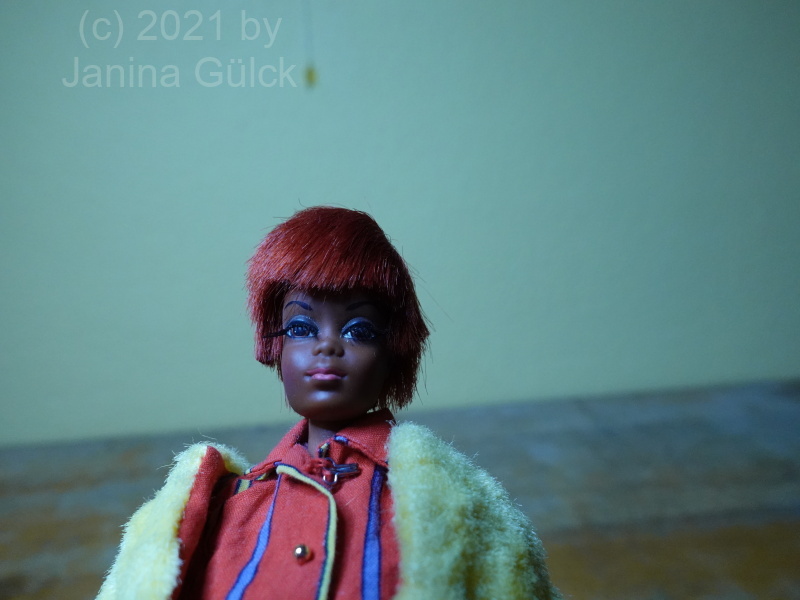
Have you been wondering how they did these real eyelashes of the Mod Barbie dolls starting in 1967 with the Twist n Turn Barbie?

Well, originally this was done by a sewing machine. I really admire everyone being able to do this with a sewing machine. I’m not able to do this but I found my own way how to do this without a sewing machine but by hand. From my experience I can tell you it’s a lot of work and it’s time consuming to get these little lashes back it.

It is possible to repair missing or damaged lashes without a doubt. However you need some skills, the right needle and a lot of patience.

I will give you a short video instruction below.

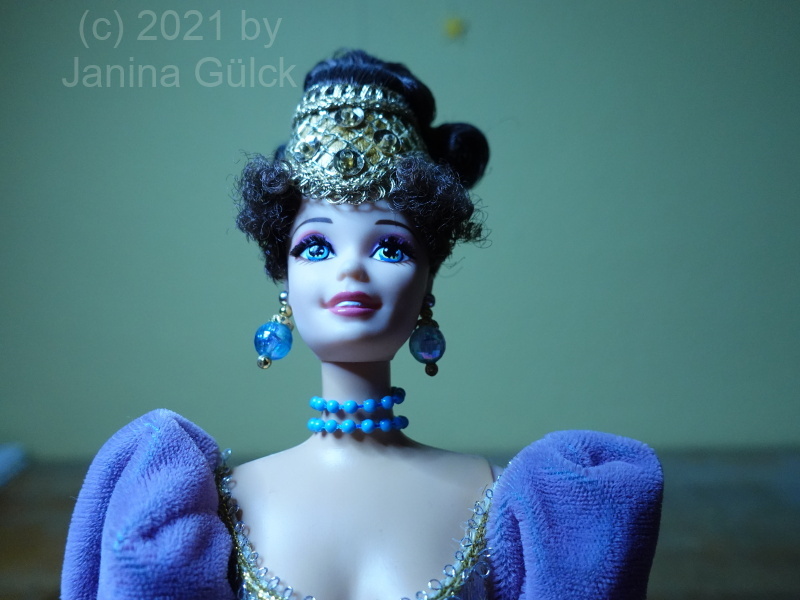
Like mentioned above it’s possible to repair but it’s a lot of work and I think this was stopped after several years due to costs. In the late 90s some collector dolls like the ones from the Great Eras serie suddendly had them again but the had much more lashes in the end than the late 60s and early 70s Barbie dolls. For reasons of comparison I will give you some pics below.

DSC08073
Twist n Turn Julia 1967
DSC08068
French Lady from the Great Eras series, 1997 made for collector market